| | |
Theta Xi Chapter House
1730 La Loma Avenue, Berkeley, CA
Kingman Hall (photo: Daniella Thompson, 2009)Few houses in Berkeley (or anywhere, for that matter) can boast the picturesque setting and the colorful history of Kingman Hall, the student co-op at 1730 La Loma Avenue. Perched above the oak-wooded canyon of Strawberry Creek, the building overlooks a sunken garden with a creekside amphitheater. Built in 1914 for Nu Chapter of the Theta Xi fraternity, the building faithfully mirrors the history of both Berkeley and the campus over the greater part of the 20th century. In fact, it can be said to be a microcosm of our city during each phase of its history over the past 95 years.
Theta Xi, an engineering fraternity, established its Berkeley chapter on 22 March 1910. The first ten members took up residence in the old Kappa Sigma house at 1739 Euclid Avenue—an ornate High-Peaked Colonial Revival affair designed in 1900 by Thomas D. Newsom. The original owner was Demetrius Satoff, a Bulgarian-born shoemaker and realtor doing business at 2121 Center Street.
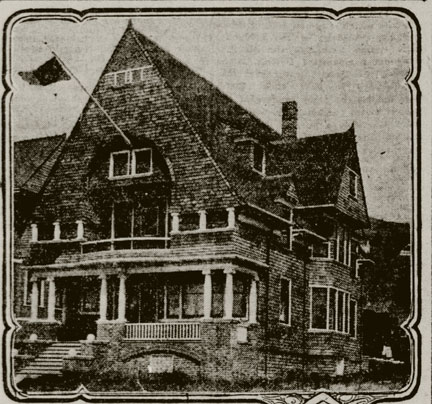
The first Theta Xi house at 1739 Euclid Ave. was designed by Thomas D. Newsom. (San Francisco Call, 29 March 1910)Four years after its founding, Nu Chapter arranged for more desirable lodging. On 3 May 1914, the Oakland Tribune announced:
Theta Xi will move on August 1 to occupy their new $27,000 structure at Le Conte and La Loma. This house is the gift of wealthy alumni and is complete in every detail. It contains accommodations for thirty besides the sleeping porches and two guest rooms. A billiard room in the basement is also being planned for. The first floor outside will be constructed of brick and the remaining two stories will have a rough plaster finish.
The completed building, a 25-bedroom dormered country villa with a triple-arch entrance loggia, ended up entirely stucco-clad with the exception of its brick base. The architects listed in the building permit were Drysdale & Thomsen, Sharon Building, San Francisco. The contractor was the Barry Building Co. of Oakland.
Theta Xi chapter house shortly after completion (Picturing Berkeley, courtesy of Sarah Wikander)Charles W. Drysdale (1872–1918) was the right-hand man of eminent San Francisco architect George W. Kelham (1871–1936), who had his offices in the Sharon Building, which he had designed. Constructed in 1912, the building teemed with architectural offices, but it’s not likely that Drysdale & Thomsen had an independent practice, since both worked for Kelham. Harry A. Thomsen, Jr. (1886–1979) began as a draftsman in Kelham’s office before becoming an architect, rising to partner, and succeeding Kelham as principal�after the latter’s death.
Kelham received his architectural training at the �cole des Beaux-Arts in Paris and in 1898 joined Trowbridge & Livingston of New York as a designer. In 1906, he was dispatched by this firm to San Francisco as project supervisor for the rebuilding of the Palace Hotel, which had been devastated in the earthquake. Here Kelham opened his own office, and in October of the same year brought Drysdale out from Chicago to run his office.
Charles W. Drysdale was born in Illinois and worked for a while in Washington, D.C. For a dozen years before his premature death he oversaw all of Kelham’s major architectural projects, including the rebuilding of the Palace Hotel, supervising the building of the Panama Pacific Exposition (1915), and designing the Carnegie (Main) Library at the San Francisco Civic Center (1917).
Under George W. Kelham, Charles Drysdale was involved in the design of the Panama-Pacific Exposition.Drysdale died suddenly of heart failure on 4 September 1918. His obituary, published the same month in The Architect & Engineer, informed:
[...] A short time before his death Mr. Drysdale was conversing with his chief and apparently was enjoying the best of health. He expired at his desk before medical assistance could be procured. Mr. Drysdale came to Mr. Kelham from Chicago in October, 1906, and had been intimately associated with him in carrying out all the large projects that have been handled by Mr. Kelham since taking up the practice of architecture in San Francisco. Mr. Kelham was especially pleased with Mr. Drysdale’s work in connection with the building of the Carnegie Library in the San Francisco Civic Center. The minutest detail was not overlooked here. Mr. Drysdale personally designed and superintended the construction of the new Elks’ home in San Rafael, himself being an active member of that order. Mr. Kelham pays a high tribute to the worth and character of the deceased. “He was the fine type of man and in every way a credit to the profession,” said Mr. Kelham. Mr. Drysdale was 45 years old and is survived by a widow.
San Francisco Old Main Library (photo: Carnegie Libraries of California)Kelham would go on to succeed John Galen Howard as the University of California’s supervising architect, a position he retained from 1927 until his death in 1936. His Berkeley designs include Bowles Hall (1928–29); the Life Sciences Building (1930); International House (1930); Moses Hall (1931); McLaughlin Hall (School of Engineering, 1931); and Harmon Gymnasium (1933, now altered beyond recognition).
After Kelham’s death, his practice was continued by Thomsen, who designed the Spreckels Sugar Company’s plant in Woodland, CA (c. 1938) and collaborated with William Wurster on the design of the Valencia Gardens Public Housing in San Francisco (1939–1943, demolished 2005). Valencia Gardens was featured in the exhibition “Built in U.S.A.: 1932–1944,” mounted by the Museum of Modern Art, New York City, in 1944. In 1947, Thomsen designed the Pacific Telephone and Telegraph exchange building in San Jose followed a year later by the phone exchange in Pittsburg. Also in 1948, he designed the addition to Kelham’s Standard Oil Building at 225 Bush Street, SF.
Having worked with landscape architect Thomas D. Church on Valencia Gardens, Thomsen, now with partner Aleck L. Wilson, teamed up with Church again to design garden apartment for Metropolitan Life Insurance’s Parkmerced complex (1941–1950) in Daly City, where every living room faced a landscaped patio. In the late 1940s, Thomsen & Wilson designed telephone company buildings in Palo Alto and Redwood City, followed in the early 1950s by A.P. Giannini Junior High School and an addition to the Metropolitan Life Insurance Company building, both in San Francisco. In 1951, they were selected to design the State of California Department of Employment building in Sacramento, but their modernist design lost them the project. (Architectual Forum reported in 1952: “For adhering to contemporary design, Thomsen and Wilson will forfeit a $250,000 fee.”) Thomsen retired about 1970 and died in Santa Clara County.
Theta Xi chapter house in a 1920 Berkeley promotional brochure (photo: E.J. McCullagh)Drysdale & Thomsen’s design for the Theta Xi chapter house was apparently a success, for in October 1914, a mere ten weeks after it had opened, the building was selected by the students’ executive committee to serve as housing for the varsity football squad during its last weeks of training.
Theta Xi’s Nu Chapter resided at 1730 La Loma Avenue until 1964. Their secret initiation rites, traditionally held in a dark hall in the basement of the building, were the subject of rumors. Craig Healy, resident of the house from 1969 until 1972, occupied this basement room for a time. He describes it as a large, windowless 20’ x 30’ room. Mr. Healy remembers that at least twenty framed caricatures used to hang on the walls during his residence there. These caricatures depicted members of the fraternity who were BMOC (“Big Men on Campus”) during the ’50s and early ’60s. Mr. Healy also remembers scores of gold-painted, five-pointed wooden stars lined up in a rack on the wall of this basement room.
Trouble began on 4 October 1959, when a physics student by the name of Donald S. Wood limped into Cowell Hospital. Two days earlier he had been initiated into Theta Xi, and now he was suffering from acute nephritis. While young Wood was reluctant to talk about what had taken place, his father, a Los Angeles aircraft company executive, charged that Donald had been beaten with a paddle and forced to eat a large chunk of raw liver.
The Wood incident took place shortly after a University of Southern California student had choked to death on a piece of raw liver during his fraternity initiation, and California Attorney General Stanley Mosk issued a stern warning against such practices. U.C. officials and the Berkeley police launched an investigation to determine whether hazing had taken place.
Oakland Tribune, 16 October 1959
Such was the uproar that State Senator Fred S. Farr announced his plan to introduce a bill prohibiting freshmen from joining fraternities and sororities, saying that it would give students time to exercise mature judgment and help eliminate irresponsible hazing practices. The system, claimed Senator Farr, was particularly bad at Berkeley, where many students dropped out when they failed to be pledged. “This is a major loss, not only to the individuals but to our society, which can’t afford to let good brains be wasted,” said Farr.
Three weeks after his initiation, Donald Wood was still in the hospital. The investigation revealed that he was put through a series of exercises that contributed to his physical exhaustion, in violation of university policy. He had not been given raw liver but fed mush with a color additive, and he was accidentally struck in the stomach with a paddle. Dr. Glenn Seaborg, then the Berkeley campus chancellor, announced that the university was withdrawing recognition of Nu Chapter for one year. In addition, seven of the chapter’s officers were placed on probation for the duration of the academic year. The Woods elected not to press charges.
Youthful anti-establishment sentiment in the 1960s robbed fraternities of their cachet, shrinking their memberships. Simultaneously, the university exerted pressure on the Northside Greek-letter societies to move south of campus. Theta Xi’s Nu Chapter disbanded in 1964 and was not reestablished until 1977.
The fireplace in the creekside amphitheater is original, but the stone seats are a recent improvement, financed by a grant from the Chancellor’s Community Partnership Fund. (photo: Daniella Thompson, 2009)With the fraternity gone, the building at 1730 La Loma Avenue became a student rooming house popularly known as Toad Hall. Between 1964 and 1969, it housed male students, turning co-ed after it was purchased by Harold Mefford, a Castro Valley and Hayward attorney who had just co-founded the East Bay’s largest builder of low-income housing, the Eden Housing Corporation.
Mefford’s professed intention was to provide affordable housing to students, but he rented to all comers. Craig Healy, a Toad Hall resident during the Mefford period, says that the house functioned more like a commune than a rooming house. One of the residents was Joy, Country Joe McDonald’s personal secretary, who lived in a basement room. Author/Merry Prankster Ken Kesey and rock star David Crosby used to buy their drugs from one of Toad Hall’s residents, and their cars were often seen parked in front of the house. In the late 1960s and early ’70s, Toad Hall was an epicenter of the Berkeley counterculture—the coolest place to live.
The neighbors weren’t thrilled. A complaint letter dated 27 October 1969 from neighbor Elena Herr to the Zoning Officer stated:
[...] it is again used as a rooming house with kitchen facilities for couples and single people, who by the way, seem little permanent and some rather strange. The house’s appearance has deteriorated in such a way that it is a threat to the neighborhood. Blankets and pieces of cloth hang from the windows in the way of curtains and the front lawn is being used as a parking lot. In order to reach it the cars go over the sidewalk, or the neighbor’s property. Cars and motorcycles are also being repaired there. It is also unlikely that the building meets the city standards of health and safety. There are at least three dogs that have caused much nuisance barking, and even running after children with the intention of biting. They have also come into my property and destroyed flowers [...]The Mefford era was short-lived. In 1973, he sold the building for $127,000 to the Living Love Center, a non-profit organization led by Ken Keyes Jr., author of Living Love—a Way to Higher Consciousness. The center conducted Weekend Consciousness Growth Intensives and disseminated “The Living Love Way” via broadcasts on KQED-FM every Saturday evening from 7:30 to 8:00.
The Living Love Center’s brochure provided the following information:
The Weekend Consciousness Growth Intensive is based on the rapid, modern methods described in the Handbook to Higher Consciousness by Ken Keyes, Jr. [...] We use simple living arrangements in which the participants of the Intensive sleep on a carpeted floor of a large room. The morning breathing exercises are done without clothing. We suggest that you bring a blanket or sleeping bag, a towel, toilet articles, and simple clothing. We request no drugs be brought into the Center, and that there be no sexual activity during the Friday through Sunday period of the Intensive. We ask that you bring no children or pets for they could interfere with concentrating on the program. Wholesome food is provided.The neighbors found no reason to be satisfied with the new arrangement. A request for service dated 8 May 1973 notes the following complaint:
“A very large bus, possibly a converted Greyhound, used as a permanent living quarters by its owner, is parked conspicuously in the front yard of 1730 La Loma.” “Ugly & offensive.”The follow-up report states:Discussed situation with Kenneth Keys [sic]. He has purchased the property and is temporarily living on the bus because he is a paraplegic [...]Two years later, on 16 June 1975, a memo from Zoning Officer Robert B. Humphrey stated:
Mrs. Elena Herr, 1731 La Loma Avenue, has complained to me about the use of the property at 1730 La Loma Avenue. This is the old Abracadabra Fraternity now occupied by the Living Love Center, founded by Ken Keyes [...] They are the owners since 1973. Mr. Keyes characterized the use of the premises as “monastic” and not unlike a fraternity [...]
Mr. Keyes states that they are tax exempt as a religious organization and operate on a non-profit basis. During the time we talked, a quite audible moaning noise could be heard. Mr. Keyes said it was part of their activity, but seemed reticent about particulars [...]
Robert Humphrey had apparently confused Theta Xi with the real Abracadabra Fraternity, a local organization found only on the Berkeley campus. In the mid-’60s, this fraternity merged with the Delta Chi California Chapter, which thereafter took on the name Abracadabra.
The battle to dislodge the Living Love Center continued for four years, with numerous complaints from neighbors, city inspections, and inter-departmental memos. But all attempts were to no avail. Then the center itself decided to pull up stakes. Mrs. Elena Herr, who had lived on La Loma Avenue since since 1961, recalled that there had been a movement afoot to make the center pay taxes, and that was the reason for its relocation. The center itself claimed it had outgrown the premises. On 22 November 1976, the center approached the city of Berkeley with an offer to donate the property for park use if it could be determined that it was located on the Hayward fault line. The city declined the offer. Mrs. Herr stated that a neighbor who was a developer wished to buy the property and build apartments there, and she brought the matter to the attention of the University Students’ Cooperative Association (USCA), suggesting they buy it. The building was, in fact, sold to the co-op for $300,000 in 1977.
Kingman Hall in the 1990s (photo: Kingman Hall)
The ancient house dog Xochitl, now deceased, at the entrance (photo: Kingman Hall)
The Living Love Center, 1730 LaLoma St., has been sold to the University Students’ Cooperative Assn. for $300,000, it was announced. Escrow is expected to close June 15 and the sale is contingent on financing arrangements. The Living Love Center, a communal “consciousness growth school teaching the science of happiness” is moving to a 115-acre farm-university in St. Mary’s, Ky., according to Marsha Laughter (pronounced Law-ter originally, now pronounced mirthfully as it looks). The center, based in Berkeley since 1972, will become the “Cornucopia Institute” in Kentucky, Mrs. Laughter said.The Daily Californian,
24 May 1977USCA dedicated 1730 La Loma Avenue in October 1977 as Harry Kingman Hall, in honor of the general secretary of Stiles Hall (University YMCA), who in February 1933 inspired 14 U.C. students to start the first student housing cooperative in Berkeley.
Sometime after the landmark designation of the building, Kingman Hall replaced the 2nd- and 3rd-story windows with aluminum ones. The original windows were made of wood, with true divided lites in the upper panes. The new windows have dark frames and internal grilles between solid panes. The window replacemet appears to have been done without a permit from the Landmarks Preservation Commission (photos: Daniella Thompson, 2004)
The 50 residents of Kingman Hall carry on the traditions of their various predecessors in the annual Living Love party, an initiation rite that takes place each fall. This writer had occasion to witness a small part of the ceremony when she went over to complain of the loud shrieks emanating from the creekside garden one evening. Residents and initiates dress in toga-draped sheets; one by one, the newbies descend, book in hand, into the dimly lit entrance hall, where an electronic keyboard provides eerie background music. Whether this tradition incorporates occult artifacts from the Theta Xi fraternity is not publicly known.
Kingman Hall was designated a City of Berkeley Landmark in January 1999. The Theta Xi chapter house is now located in the Cornelius Beach Bradley House (Edgar A. Mathews, 1897) at 2639 Durant Avenue, designated a City of Berkeley Landmark in November 1997.
The butterfly gate on Le Conte Ave. is the latest installation in the Kingman amphitheater improvement project. (photo: Daniella Thompson, 2009)
Kingman Hall from the air in 1994. The wooded thicket left of the parking lot conceals a creekside patio and amphitheatre. The small house below Kingman Hall is the Lydia & William Atterbury house (McCrea & Knowles, 1898) at 2656 Le Conte Ave. Several large oaks used to grow in the middle of Le Conte Ave. to the left. The cutting down of one of them generated the outpouring of sentiment expressed in this protest letter to the Berkeley City Council. Click the photo for an aerial view of Daley’s Scenic Park.
O shorter version of this article was published in the Berkeley Daily Planet on 21 January 2009 under the title “Kingman Hall: a Microcosm of 20th-Century Berkeley History.”
Copyright © 2003–2019 Daniella Thompson. All rights reserved.