

Understanding Berkeley’s New Wave of “Entitle, Demolish, and Stall”
by Leila Moncharsh
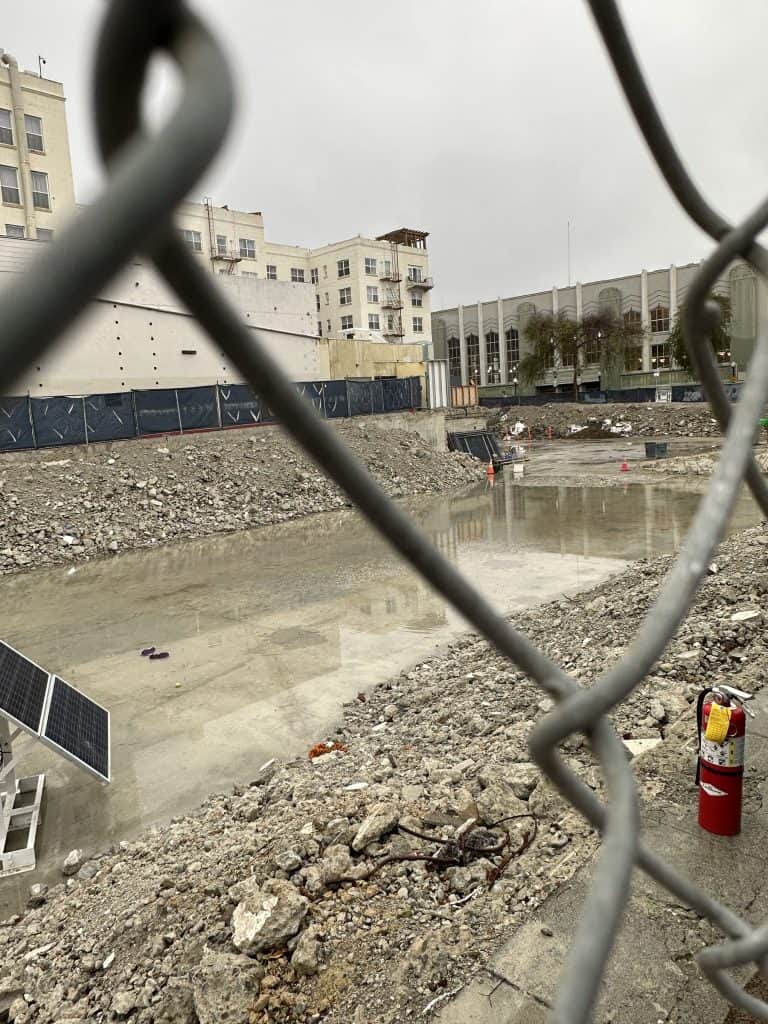
Across Berkeley, residents are seeing the same troubling pattern: beautiful buildings are demolished, lots are cleared, permits are granted … and then nothing happens. No construction. No new housing. Just fenced‑off dirt. It’s not your imagination, and it’s not a coincidence. This is a new development strategy shaped by state law, financial markets, and the rise of institutional investors — and it has very little to do with actually building the much‑promised housing.
Here is what is most likely going on, and why preservationists and community members are increasingly alarmed.
Under California’s SB 330 (the “Housing Crisis Act”), once a developer files a preliminary application, the rules governing the property are frozen: zoning, height, density, fees, and design standards. This freezing dramatically increases the land’s value – even if nothing is ever built by eliminating regulatory risk for future buyers. An SB 330 filing is not just a housing application. It is a land‑value enhancement tool.
Historically, people assumed that deeds would transfer to developers who would build new housing, increasing supply and lowering prices. But deeds have always been investment instruments as well. In the 1980s, foreign investors bought California properties as speculative assets, leaving many units empty or neglected. In the 2000s, lenders bundled mortgages into financial products, and when the bubble burst, investors ended up with the deeds.
There is a rising awareness that California may be going through another type of speculative investment scheme regardless of whether by design or because of well-meaning politicians who think they can and are somehow legislating the price of housing.
Once a building is demolished, the parcel becomes what investors call a “clean site.” A clean site has no tenants, no relocation obligations, no rent control, no habitability or maintenance issues, no code enforcement risk, and no historic‑resource arguments. A cleared lot with SB 330 rights attached is a highly marketable asset, even if the developer never intends to build.
Berkeley residents have also noticed that SB 330 applications often coincide with lot aggregation — multiple parcels purchased in a row, demolished, and merged into one large site. A single large parcel is far more valuable to investors than several small ones.
Developers, planning staff, and elected officials often claim that projects are “stalled for macroeconomic reasons” and that construction will resume when interest rates fall or materials become cheaper. But California construction has always been expensive, risky, and sensitive to market swings. What has changed is the business model.
Many entities buying land in Berkeley today are not builders. They are entitlement platforms — companies whose business is to acquire multiple parcels, file SB 330 applications, secure demolition and building permits, clear the land, and sell the entire package to a large investor. This is not development. It is financial engineering using land as the underlying asset. And it is extremely profitable.
Residents opposing recent upzoning proposals for neighborhood commercial zones have warned that these areas will be wiped out. They are not wrong. Small, one‑ or two‑story commercial buildings beloved by the community have little investor value. To unlock higher returns, investors must demolish the buildings, aggregate the lots, attach SB 330 entitlements, and market the site to institutional capital (investment companies, banks, real estate investment trusts, crowdfunding companies, limited liability investment corporations, and the like.)
A three‑parcel site entitled for 120 units is far more valuable than three small infill lots. That is why Berkeley is seeing aggressive acquisitions, fast demolitions, and large, generic building diagrams — followed by no action. The deed then moves into one or several investment companies, including private equity funds and REITs. These entities may hold the land for 5–10 years, collecting investor distributions while the property appreciates.
The “plans” shown to the public are not community‑oriented designs. They are marketing materials for investors, signaling that the land is shovel‑ready and construction risk has been minimized.
With construction financing costs at historic highs, many developers simply cannot build right now. But they can entitle, demolish, hold, refinance, or sell later when conditions improve. Vacant land has become a speculative asset, not a construction site.
What about property taxes? Demolition does not reduce property taxes.
In California, land value is the majority of the assessment. Taxes reset to the purchase price when the property changes hands. Demolition only removes the (often minimal) value of the old structure, and vacant parcels may incur additional taxes or fees due to bond measures, etc. For investors, the tax bill is negligible compared to the potential appreciation of entitled land.
The outcome is predictable: demolition without housing, empty lots, loss of below‑market‑rate units, loss of historic buildings, disrupted streetscapes, no new housing, no community benefit, and no accountability. Turning pre‑1940 housing into dust for the purpose of creating speculative investments threatens the very qualities that make Berkeley vibrant: its architecture, its small businesses, its cultural identity, and its sense of place.
When demolition becomes a step in a financial strategy — rather than a step toward construction — the city loses its heritage, its unique qualities that differentiates it from “Anywhere USA,” and its trust in local and state officials. The public is left wondering why no housing is being built.