

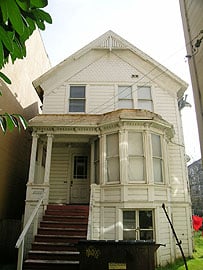
On April 26, 2017, Berkeley landmarked the A.H. and Julia Broad House and Broad apartment building (Landmark #326). The architect was Alphonso Herman Broad. The house at the back of the lot was built in 1887 (it was moved from the front of the lot to build an apartment building). As stated in the archived BAHA website “the Broad House and Broad Apartments are rare survivors from a time when the downtown streets crossing Shattuck Avenue were primarily residential.” The request to destroy them is on the LPC agenda for July 2nd. BAHA opposes the destruction of even more Berkeley history and has written the following letter to the Landmarks Preservation Commission:
LPC Commissioners:
The Berkeley Architectural Heritage Association strongly opposes the demolition of the A.H. Broad buildings at 2030-2032 Bancroft Way.
Evidence of Berkeley’s nineteenth century downtown is fast disappearing. Our City can afford to preserve a few artifacts of the downtown’s early development, even while rapidly expanding our housing supply. A.H. Broad was an essential part of the construction of Berkeley’s early downtown, and the two structures at 2030-2032 Bancroft Way bookend his prolific career, providing a unique time capsule into that whole period of development.
Furthermore, we are opposed to the idea that landmarks designated by the City of Berkeley should simply be discarded because they are inconvenient for a property owner’s chosen density of development. The 2036 Bancroft Way site could easily accommodate lower density development (~40 units) at the location of the Corder Building addition, leaving 2030-2032 Bancroft Way intact. Such a building would probably resemble the development previously undertaken by the applicant at 2028 Bancroft Way.
The preservation of landmarks is a basic function of the Landmarks Preservation Commission. When demolition of a landmark is proposed, the LPC is explicitly authorized to take “such steps as it deems necessary to preserve the structure concerned” (BMC 3.24.250). Although State law now heavily circumscribes the ability of the LPC to delay a proposed demolition, there are still many ways the LPC can and should support the preservation of threatened landmarks.
1. The LPC can use the public hearing process to hold the applicant to account for the demolition and strongly encourage alternatives that preserve the landmarks.
2. The LPC can “suspend action” on the proposed demolition for the maximum period allowable under state law.
3. The LPC can form an ad hoc committee to explore alternatives to demolition during the period of suspended action per BMC 3.24.250. The LPC is empowered to consult with “civic groups, public agencies and interested citizens” under this section of the LPO.
BAHA is actively exploring the possibility of relocating one of the Broad structures to a lot on MLK Jr. Way. It remains to be seen whether this is feasible, but our organization would appreciate assistance from the LPC. We are grateful that the 2036 Bancroft Way applicant has been responsive to our inquiries, but LPC involvement could encourage further engagement from both the applicant and public agencies.
If demolition does move forward, the EIR will require detailed documentation of 2030-2032 Bancroft Way. The EIR should also require documentation of the Corder Building addition. LPC follow-up, perhaps through an ad hoc committee, will be essential to ensure that this documentation is received by appropriate repositories and becomes publicly available.
Respectfully,
Isaac Warshauer, Chair, BAHA Preservation Committee